For six hundred years, a kingdom in Assam did what most of India couldn't: stay independent. Then they buried their kings in style.
In 1228, a Tai prince named Sukapha led about 9,000 followers across the Patkai mountains from what is now the Myanmar-China border into the Brahmaputra Valley. He was looking for somewhere to settle. He found it.
The kingdom Sukapha established would last 598 years. The Ahom dynasty ruled Assam until 1826, resisting repeated invasions from the Delhi Sultanate, Bengal, and most impressively, the Mughal Empire at its height under Aurangzeb. They outlasted the Mughals themselves. And when they died, their kings were buried in vaulted mounds that still dot the Assamese hills today.
In July 2024, those burial mounds at Charaideo became India's 43rd UNESCO World Heritage Site and the first cultural heritage site from northeastern India. After centuries of looting, neglect, and obscurity, the Ahom pyramids finally got their due.

The Ahoms were Tai people, ethnically and linguistically related to the Thai, Lao, and Shan. Sukapha's homeland was Mong Mao, a Tai kingdom near present-day Ruili in Yunnan Province, China. According to Ahom chronicles called Buranjis, he left in 1215 after losing a succession dispute. The journey took thirteen years.
What Sukapha brought with him mattered as much as the people. The Ahoms knew wet-rice cultivation, which transformed the swampy Brahmaputra floodplains into productive farmland. They had a system of government, a writing script, and a tradition of keeping detailed historical records. The Buranjis they maintained are among the most comprehensive pre-colonial historical documents in South Asia.
After years of moving between settlements, Sukapha established his capital at Charaideo in 1253. The name means "a dazzling city atop a hill" in Tai-Ahom. It would remain the sacred center of the kingdom even after the administrative capital moved elsewhere. When an Ahom king died, he was brought back to Charaideo for burial.
The moidams (the word means "home for spirit" in Tai) are not technically pyramids. They're hemispherical mounds built over vaulted underground chambers. But the comparison to Egyptian tombs isn't entirely wrong. Ahom kings were buried with grave goods for the afterlife: food, weapons, ornaments, horses, elephants. In earlier centuries, queens and servants were sometimes buried alongside them.

Ninety moidams survive at Charaideo, ranging from modest mounds to structures twenty meters high. The largest belonged to the most powerful kings. Sukapha himself was buried here in 1268.
The construction techniques evolved over time. Early moidams used wooden vaults made from a specific timber called Uriam. After the 17th century, the chambers were built with brick and stone, joined by a mortar that modern engineers find genuinely interesting. The Ahoms mixed lime, pulses, resin, molasses, and fish extracts into a binding compound that has held together for centuries in one of India's wettest climates.
Each moidam sits within an octagonal boundary wall, the shape representing the Tai universe. A small shrine on top served as a symbolic ladder between heaven and earth, where the spirits of the dead could receive offerings during the annual Me-Dam-Me-Phi ancestor worship festival. The festival is still celebrated on January 31st.
When the Archaeological Survey of India excavated Moidam No. 2 between 2000 and 2002, they found the vault had been looted (a hole in the roof made that clear) but still contained ivory decorative pieces, wooden objects, gold pendants, and the skeletal remains of five individuals. An ivory panel depicted the Ahom royal insignia: a dragon.
Most of the moidams remain unexcavated. Mughal raiders, British treasure hunters, and local looters picked through many of them over the centuries. What survives is still enough to impress UNESCO.

The Ahoms fought the Mughals seventeen times and lost exactly once.
That loss came in 1662, when the Mughal general Mir Jumla invaded Assam with a massive army. The Ahoms retreated, the Mughals occupied the capital at Garhgaon, and the Ahom king Jayadhwaj Singha was forced to sign a humiliating treaty. He died shortly afterward, reportedly of despair.
His successor, Chakradhwaj Singha, had no intention of accepting vassal status. He reorganized the army, built new forts, and appointed a new commander: Lachit Borphukan.
Lachit is now a national hero, with a statue at the National Defence Academy in Pune and a gold medal named after him. In 1667, he recaptured Guwahati from the Mughals. When Aurangzeb sent a massive force under Raja Ram Singh I to take it back, Lachit chose his ground carefully.

The Brahmaputra at Saraighat narrows to about a kilometer wide. Mughal cavalry, their main advantage, would be useless there. The fight would be on water. Lachit built mud embankments to force the Mughals toward the river, then waited.
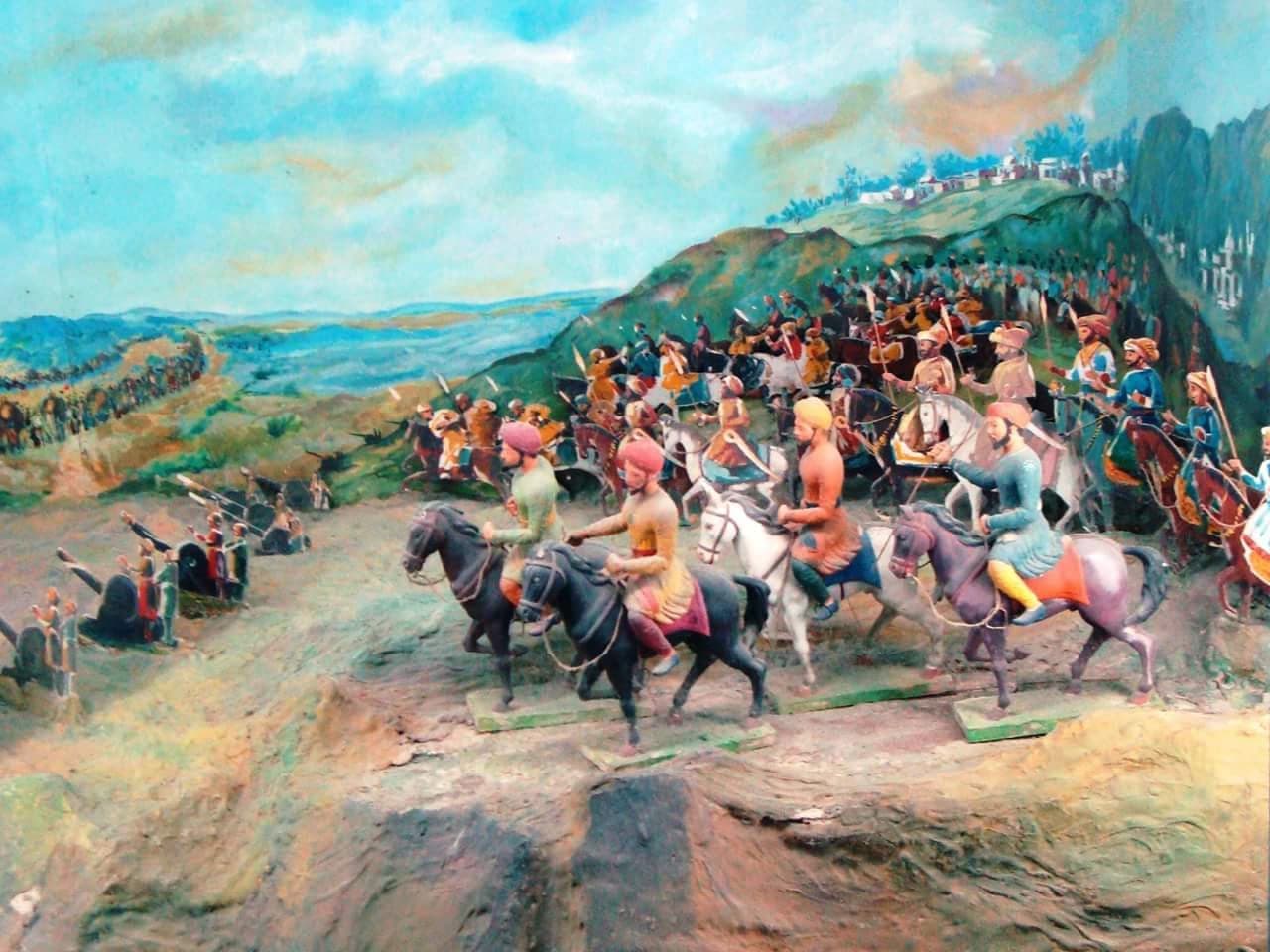
The Battle of Saraighat in 1671 was a naval engagement fought with small boats against large Mughal warships. Lachit was seriously ill and had to be carried to his boat on a stretcher. When his forces began retreating, he reportedly declared he would rather die fighting than flee, and led a counterattack that killed the Mughal admiral Munnawar Khan. The Mughals broke and retreated to the Manas River, the western boundary of the Ahom kingdom.
Lachit died the following year, probably from the illness that had plagued him at Saraighat. The Mughals briefly retook Guwahati in 1679, but the Ahoms drove them out permanently at the Battle of Itakhuli in 1682. After that, the Mughals gave up on Assam.
The kingdom finally fell not to the Mughals but to internal rebellion (the Moamoria uprising) and then Burmese invasion. The British took over in 1826 under the Treaty of Yandaboo. But the buildings the Ahoms constructed still stand, scattered around Sivasagar (the later capital, about 360 km from Guwahati).

Rang Ghar is often called one of Asia's oldest surviving amphitheaters. First built under King Rudra Singha around 1714 using bamboo and wood, it was reconstructed in brick by his successor Pramatta Singha between 1744 and 1751. The two-storey structure has a distinctive boat-shaped roof and served as a royal sports pavilion. From here, the Ahom kings watched buffalo fights, wrestling matches, and elephant fights during festivals.
The construction is notable for what it doesn't use: cement. The Ahom builders joined their thin, specially-fired bricks with a mortar made from sticky rice, duck eggs, and extract from a fish called Borali. The mixture has proven remarkably durable. The building still stands, though earthquakes and oil company surveys have left cracks in the walls.
Talatal Ghar is the largest surviving Ahom monument, a seven-storey palace complex with four floors above ground and three below. "Talatal" means underground. The palace served as both royal residence and military headquarters, with the subterranean levels functioning as army barracks and escape routes.
According to Ahom chronicles, two secret tunnels led from the underground chambers: one running three kilometers to the Dikhow River, the other stretching sixteen kilometers to the old capital at Garhgaon. The tunnels were supposedly used for escape during enemy attacks. The British sealed them after 1826, reportedly because people kept getting lost in the maze-like passages.
A ground-penetrating radar survey conducted by IIT Kanpur in 2015 didn't find evidence of the tunnels, though it detected possible underground structures near the monument. Whether the escape routes ever existed as described, or were embellished over time, remains an open question. The underground levels are sealed to visitors, but the ruins of the upper floors are still accessible.

Charaideo itself, with its ninety moidams spread across forested hills about 30 km from Sivasagar, is now the main attraction. The site has been developed for tourism since the UNESCO inscription, with a beautification project announced in 2023. The moidams are covered in vegetation now, grassy hillocks that would be easy to walk past without knowing what's underneath.
The Ahom kingdom lasted nearly six centuries. During that time, they developed a sophisticated administrative system, maintained independence against imperial powers, and left behind monuments that combine Southeast Asian building traditions with local techniques and materials. The Buranjis they wrote are still used as primary sources for Assamese history.
The descendants of the Ahoms, the Tai-Ahom community, still live in Assam and still practice ancestor worship at Charaideo. The original Tai-Ahom language is now extinct, replaced by Assamese, but efforts to revive it continue.
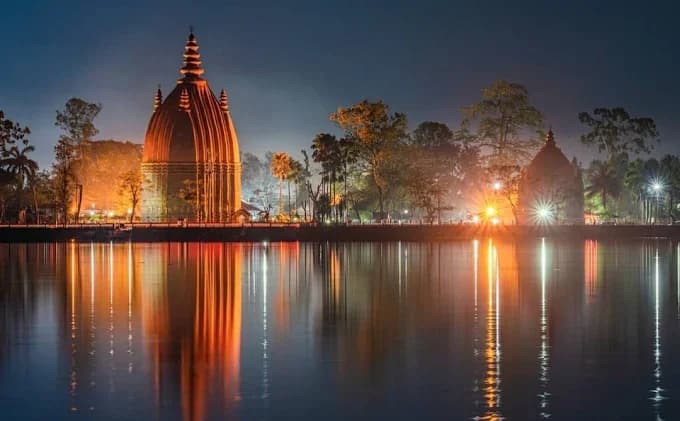
For visitors, Sivasagar offers a concentration of Ahom-era sites within a relatively small area: Rang Ghar, Talatal Ghar, the Sivadol temple complex, and the massive Joysagar tank (one of the largest man-made ponds in India, dug in the early 18th century). Charaideo is a short drive away.

The moidams themselves are quiet places now. Grass grows on the mounds. The octagonal walls are partially crumbled. The shrines on top are modest structures. But ninety Ahom kings and nobles are buried there, their grave goods mostly looted, their chambers mostly unexplored. For six hundred years, their descendants ruled a kingdom that refused to be conquered.
That seems worth remembering.
The Moidams of Charaideo were inscribed as a UNESCO World Heritage Site on July 26, 2024. Sivasagar is accessible by rail (Sivasagar Railway Station), air (Jorhat Airport, 60 km), and road from Guwahati (360 km).